
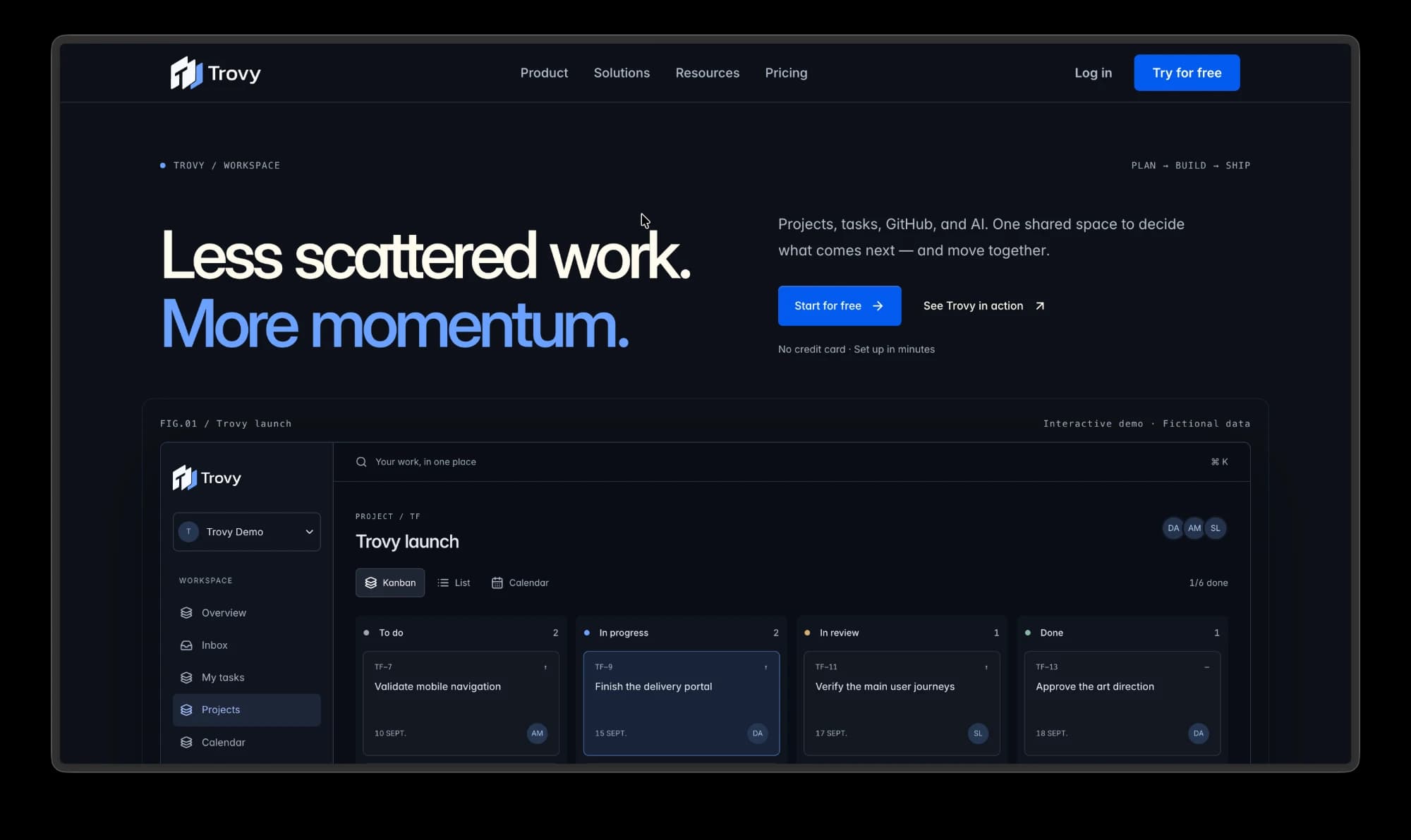
When you run several projects at once, the time you lose almost never comes from the code. It comes from everything around it: tracking down where a task stands, switching between tools, writing a progress update for a client.
The pattern is always the same. Tickets live on GitHub, tasks in a management tool, and client conversations in a third place. Every round trip costs you the thread — and worse, those three sources end up telling different stories.
That is the problem Trovy sets out to solve. Its promise fits in one line: "Less scattered. More momentum."
Connecting code and tasks
For me this is the decisive part. GitHub issues, branches and pull requests are linked to the project's tasks.
In practice, code progress and project progress stop being two separate realities. No more updating a card by hand because a pull request just merged: the information flows both ways.
Several views over the same data
Depending on the moment, you do not look at a project the same way:
- Kanban to see progress at a glance.
- List to work through tasks one after another.
- Calendar to line up deadlines.
Three readings of the same data, not three places to keep up to date.
AI assistance that asks for validation
Trovy offers to prepare a sprint, prioritise a backlog or summarise progress.
The detail that matters: the user validates before any action. An AI that reorganises a backlog on its own creates more work than it removes — here a suggestion stays a suggestion.
Seeing where things actually stall
The tool computes cycle time, throughput and blockers.
The point is not to produce charts, but to answer a precise question: are tasks dragging because they are too big, or because they are waiting for a review? Those two causes call for opposite fixes.
The client portal
This is the feature I underestimated, and the one that matters most when freelancing.
The client follows progress directly, without you writing a recap every week. It removes a recurring chore, and it changes the relationship: the client stops asking where the project stands, they can see it.
In practice
The tool is available in French and English. The free plan covers 2 projects and 3 members, which is enough to form an opinion on a real project. Paid plans start at $12 per month per workspace, with unlimited projects and members on the higher tier.
None of this is impossible otherwise: you can track tasks in a spreadsheet. What changes is the cost of repeated effort — switching tools ten times a day. It is rarely the big technical decisions that make the difference over a working week, it is friction like this, accumulated.